An inquiry into human sustainability, examined through the biogeochemical flows powered by the Sun.
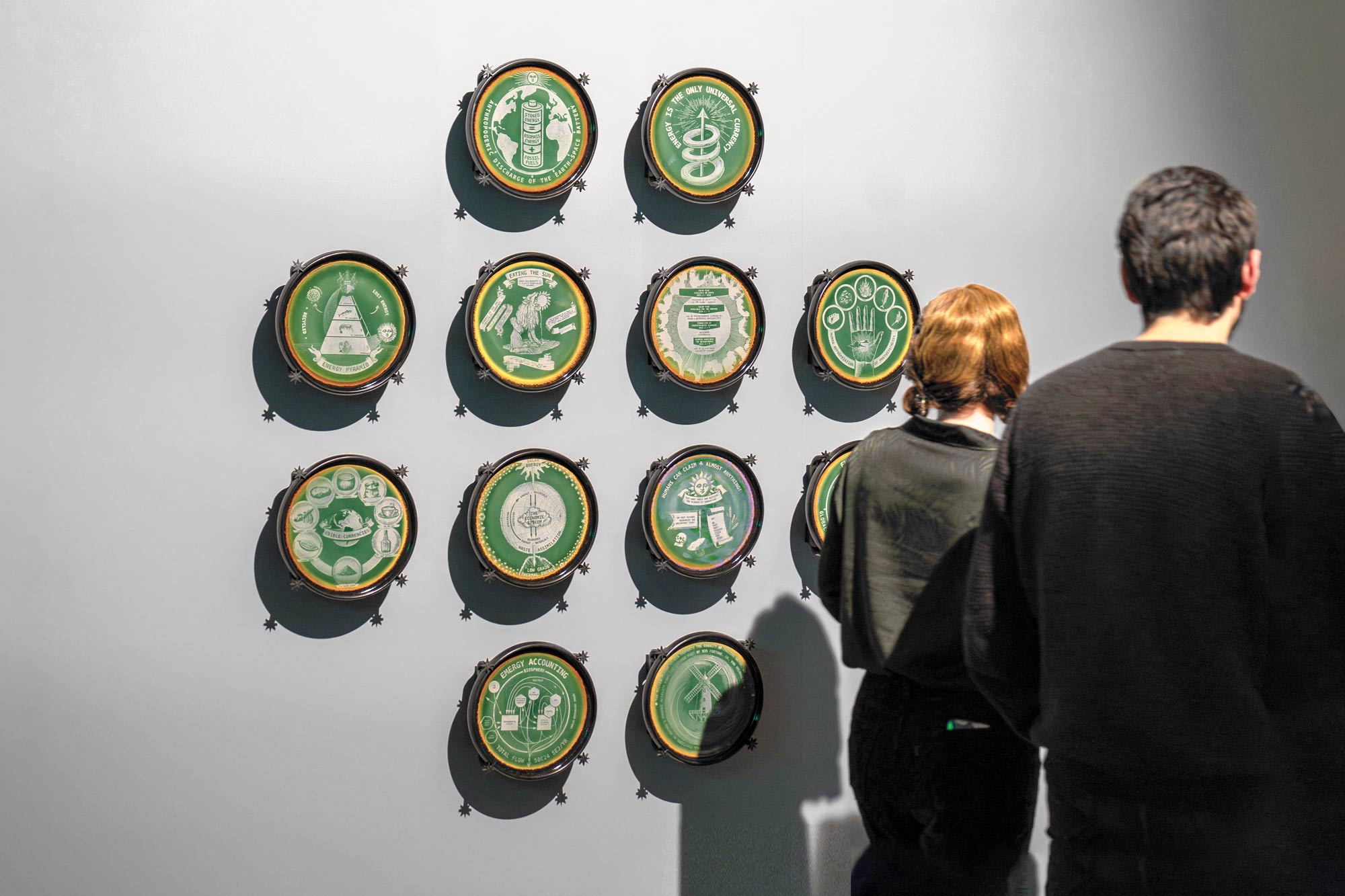
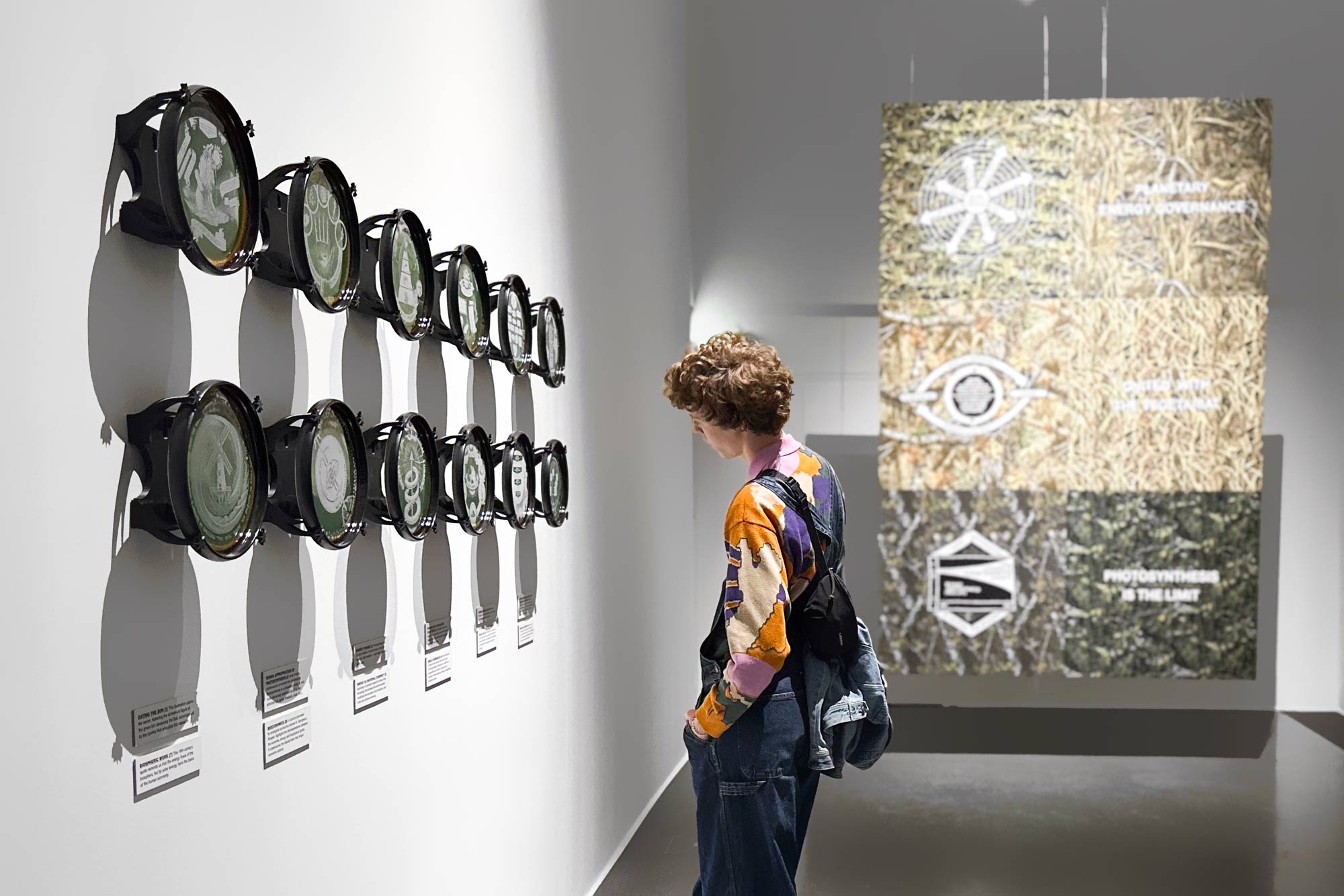
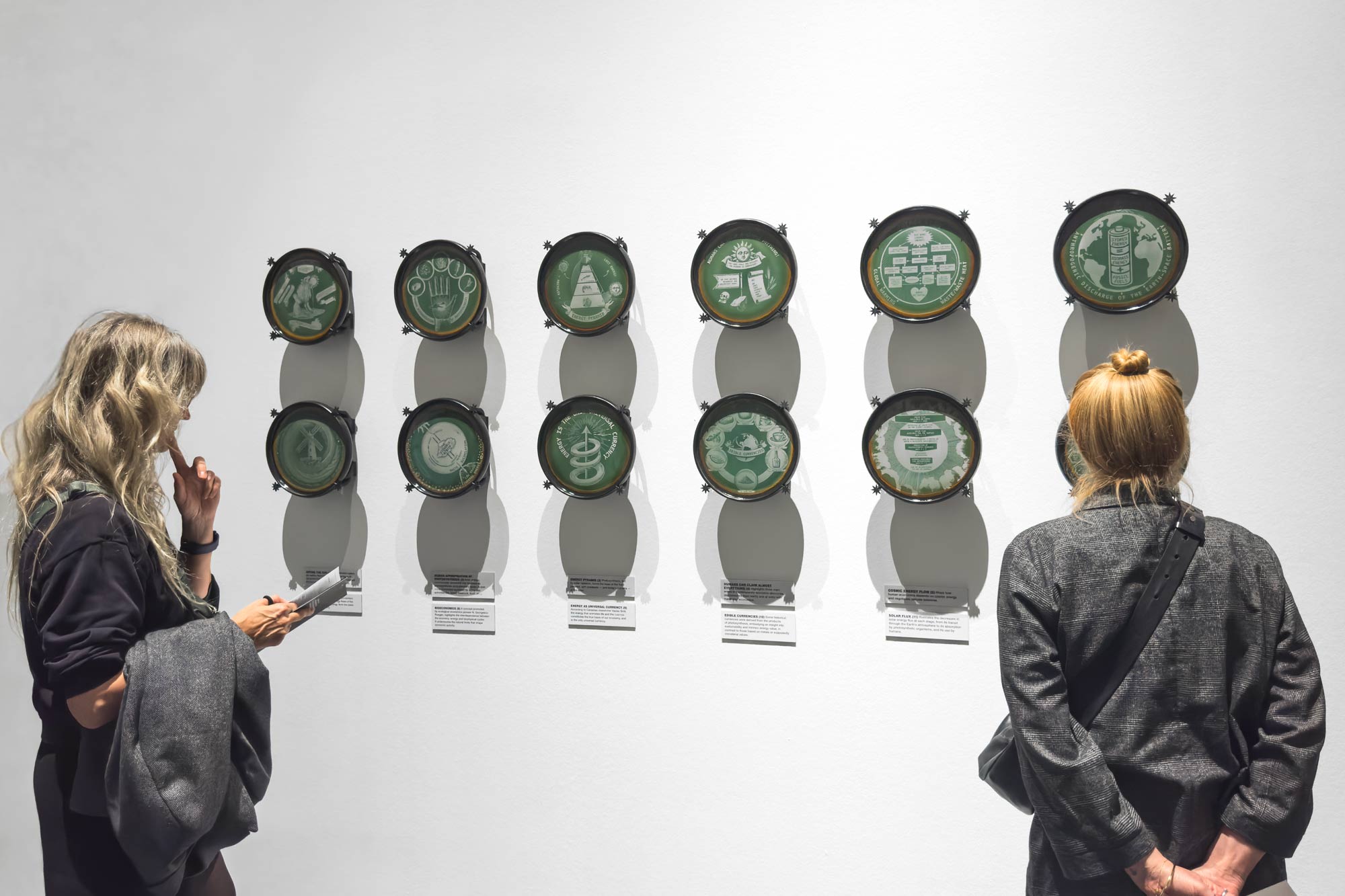
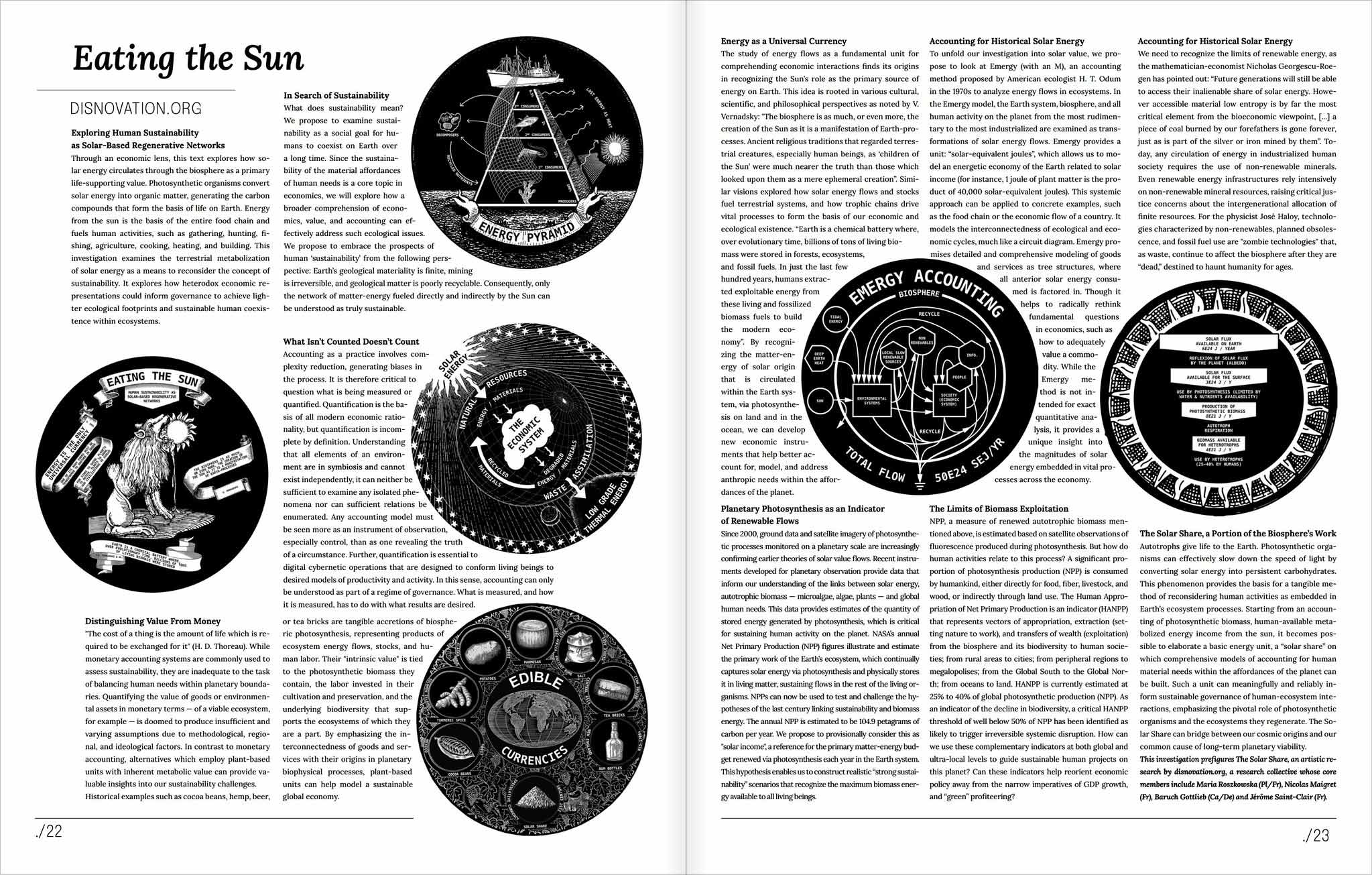
This series of twelve ceramic plates gives artistic form to an inquiry into political economy at the scale of the biosphere. Taking the Sun as the primary energy source for life on Earth, Eating the Sun situates human activities within the biogeochemical flows that make habitability possible. Food, materials, fuels, infrastructures, and techniques all depend, directly or indirectly, on the transformation of solar energy by living systems, as well as on geological stocks whose replenishment far exceeds human timescales.
Against an abstract and financialized economy detached from its material conditions, the work reopens the question of value from the standpoint of Earth’s regenerative capacities. Through an economic lens, the plates explore how solar energy circulates through the biosphere as a fundamental life-supporting force. Photosynthetic organisms convert sunlight into organic matter, producing the carbon compounds that sustain food chains, ecosystems, and human subsistence practices such as gathering, hunting, fishing, agriculture, cooking, heating, and building.
By examining the terrestrial metabolization of solar energy, Eating the Sun invites a reconsideration of sustainability beyond purely human-centered measures. The work asks how alternative economic representations might help us imagine lighter ecological footprints and more sustainable forms of coexistence within the living systems on which human societies depend.
Conception: DISNOVATION.ORG
Ceramic plates engraving: IFT De Vinci, Paris
Installation, ceramic plates, illustrations, essay | 2024
Press images on Flickr
Commissioned for the Solar Biennale 2, Soleil.s, 2025, CH
Permanent collection of MUDAC, Lausanne, CH
Commissioned by HAC-TE & the S+T+ARTS European programme
Eating the Sun (12 Illustrated Engraved Ceramic Plates)
Together, these 12 plates map a solar political economy in which food, energy, materials, and value all emerge from the same planetary metabolism.
EATING THE SUN (1) This inaugural plate invokes the alchemical figure of the green lion devouring the Sun. The image functions as a symbolic threshold: human societies do not produce the energy on which they live; they transform flows that are already there, largely mediated by the biosphere. By bringing together hermetic iconography and contemporary ecological thought, the work proposes an inversion of dominant systems of value. Wealth is no longer conceived first and foremost as a monetary sign, but as the capacity of living environments to convert light into organic matter, that is, into the conditions of existence.
Sources and further reading
Rosarium philosophorum, in De alchimia opuscula complura veterum philosophorum, Frankfurt, 1550.
Lyndy Abraham, A Dictionary of Alchemical Imagery, Cambridge University Press, 1998.
Vladimir I. Vernadsky, The Biosphere, Springer, 1998 [1926].
Vaclav Smil, Energy and Civilization: A History, MIT Press, 2017.
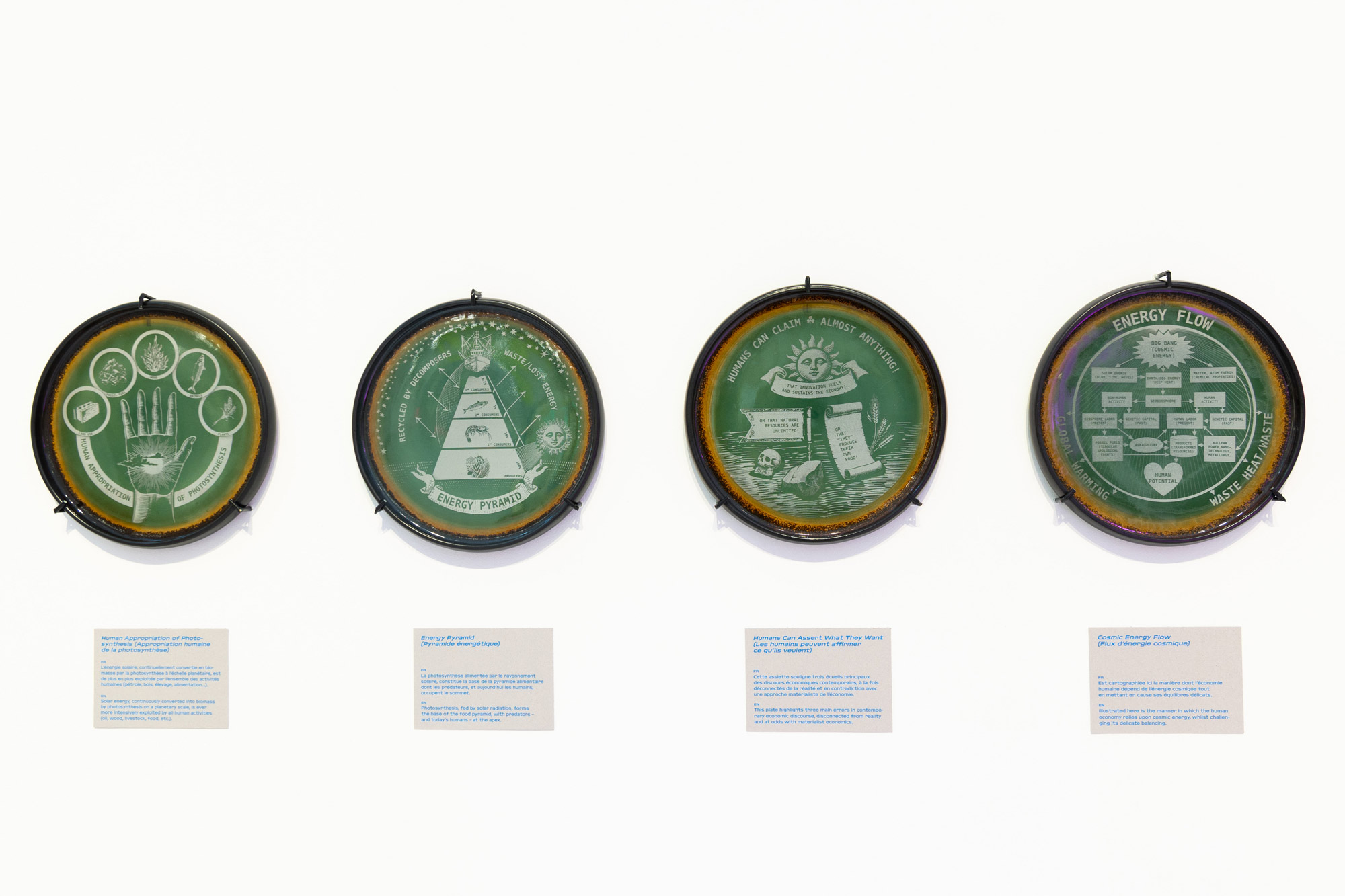
HUMAN APPROPRIATION OF PHOTOSYNTHESIS (2) By bringing together plants, animals, wood, fossil fuels, and land use within a human hand, this plate shows several regimes of appropriation of photosynthesis: annual biomass, biomass prevented by land artificialization, and ancient photosynthesis condensed into fossil fuels. Every society appropriates a share of primary production for food, livestock farming, fibers, construction, or energy. The issue is therefore not only to produce more, but to recognize that this material basis is shared with all living beings. The concept of Human Appropriation of Net Primary Production (HANPP) measures part of this appropriation, while opening up ecological, political, and geographical questions.
Sources and further reading
Helmut Haberl et al., “Quantifying and mapping the human appropriation of net primary production in earth’s terrestrial ecosystems”, PNAS, 2007.
Fridolin Krausmann et al., “Global human appropriation of net primary production doubled in the 20th century”, PNAS, 2013.
Helmut Haberl, Karl-Heinz Erb and Fridolin Krausmann, “Human Appropriation of Net Primary Production”, Annual Review of Environment and Resources, 2014.
Marc L. Imhoff et al., “Global patterns in human consumption of net primary production”, Nature, 2004.
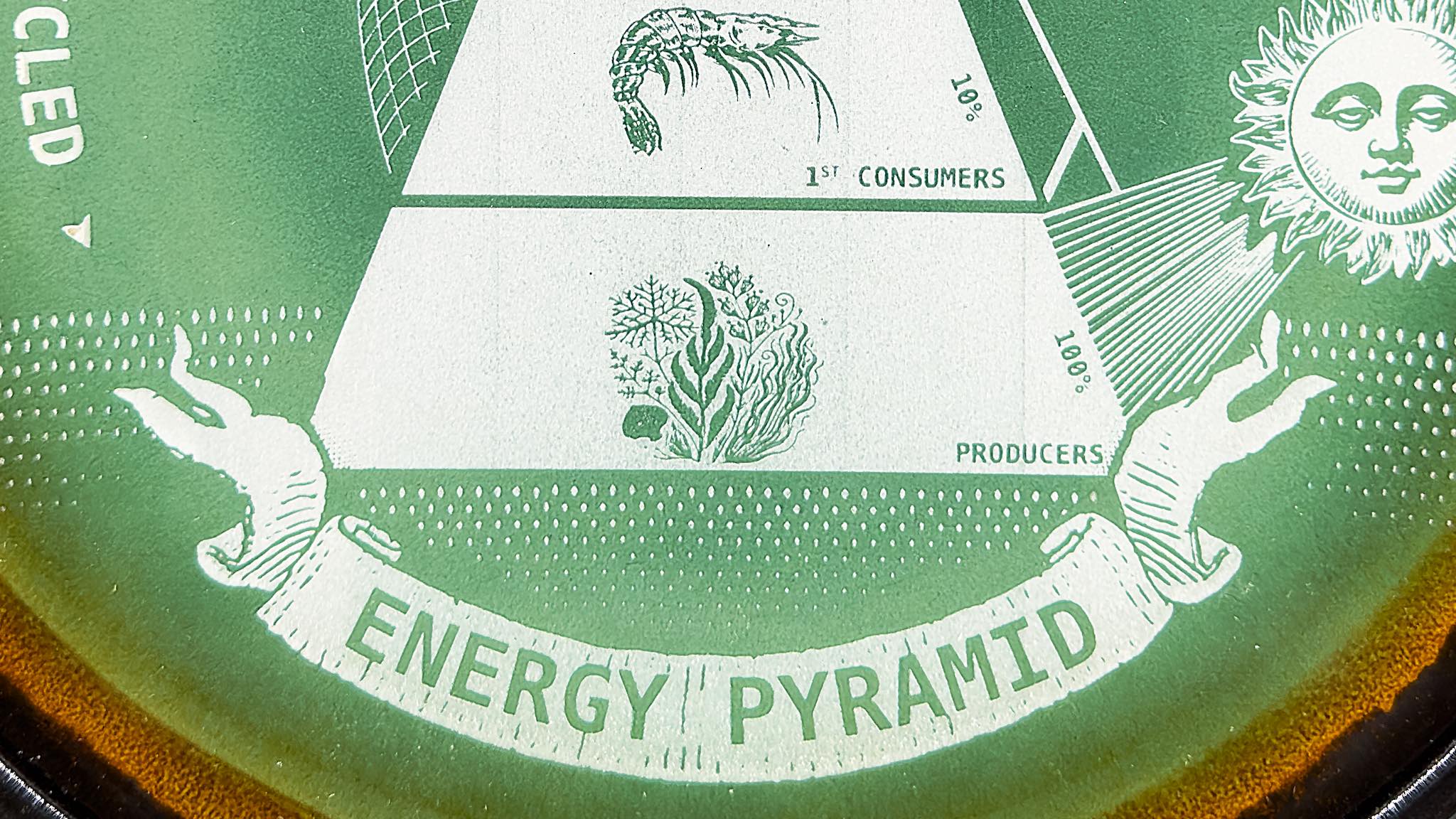
ENERGY PYRAMID (3) This plate recalls a fundamental principle of ecology: the energy available decreases at each level of the trophic chain. At its base, photosynthesis converts solar radiation into biomass; as this biomass circulates toward herbivores, carnivores, and omnivores, a large share of energy is dissipated through respiration, heat, waste, and unassimilated matter. The piece makes tangible the bioenergetic cost of our diets and technical systems. It serves as a reminder that complex societies are built upon a vast, active and fragile photosynthetic foundation.
Sources and further reading
Raymond L. Lindeman, “The Trophic-Dynamic Aspect of Ecology”, Ecology, 1942.
Charles S. Elton, Animal Ecology, 1927.
Eugene P. Odum, Fundamentals of Ecology, 1953.
Vaclav Smil, Energy and Civilization: A History, 2017.
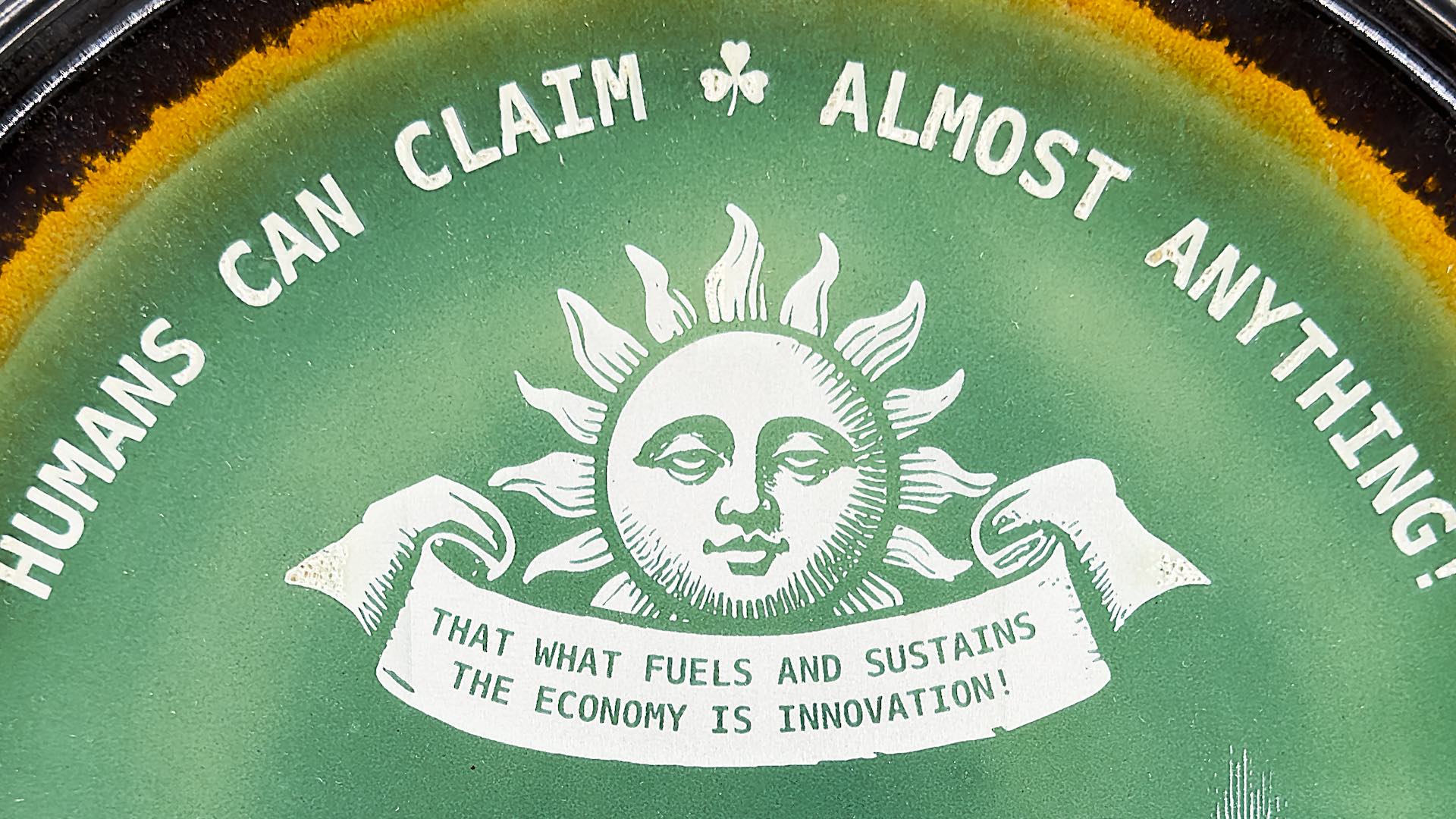
HUMANS CAN CLAIM ALMOST EVERYTHING (4) Beneath its seemingly light-hearted satirical tone, this plate challenges three contemporary economic beliefs: that innovation alone could be enough to fuel the economy, that natural resources are unlimited, and that humans “produce” their own food by themselves. By engraving them as performative proclamations, the work shows the extent to which economic language can become detached from its material conditions. It invites us to re-embed value within concrete ecological limits: soils, pollinators, biomass, water, energy, minerals, and regeneration times.
Sources and further reading
Kenneth E. Boulding, “The Economics of the Coming Spaceship Earth”, 1966.
Nicholas Georgescu-Roegen, The Entropy Law and the Economic Process, 1971.
Herman E. Daly, Steady-State Economics, 1991.
Joan Martínez-Alier, Ecological Economics: Energy, Environment and Society, 1987.
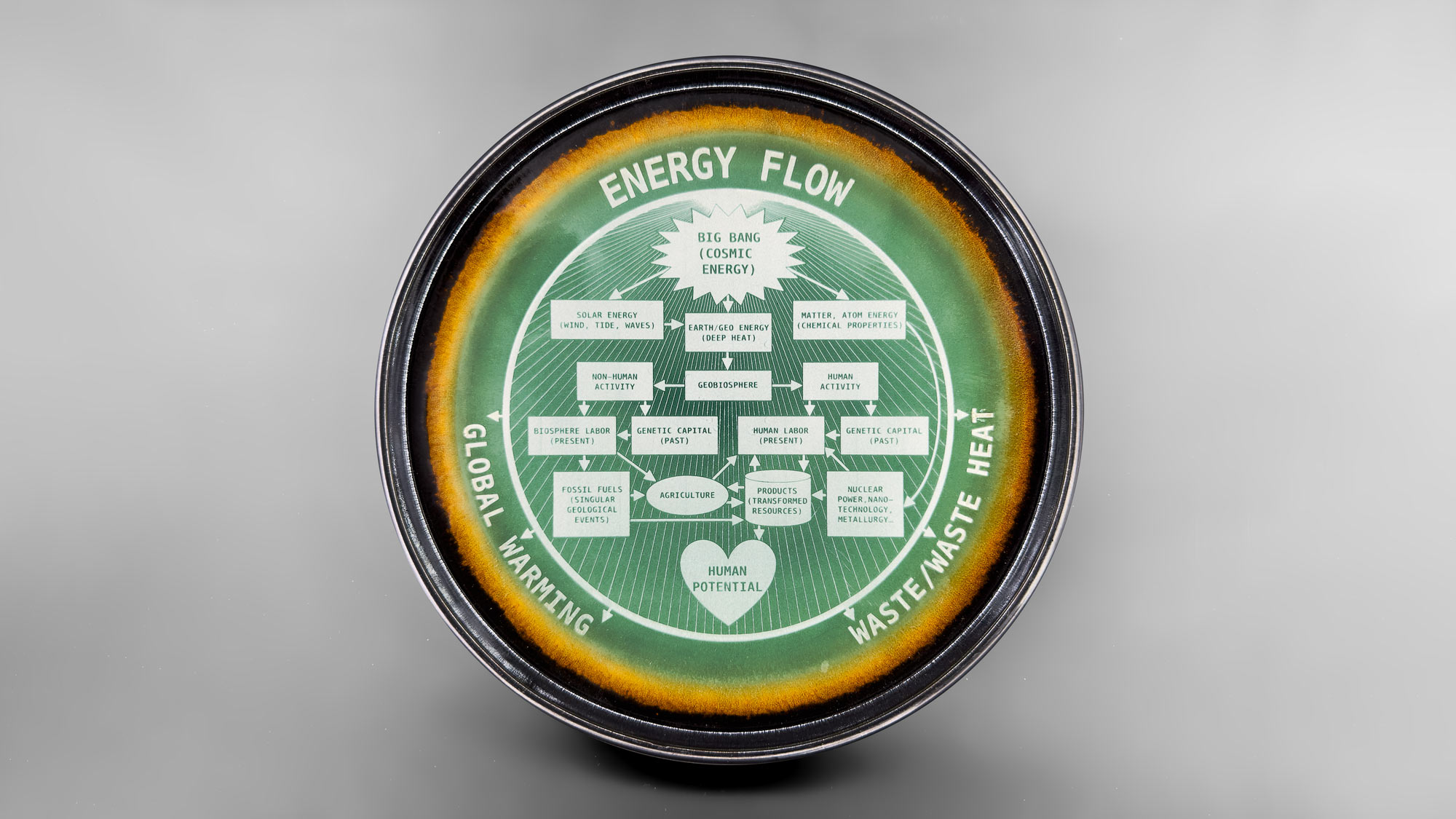
COSMIC ENERGY FLOW (5) This plate maps the relationships between cosmic energy, geo-energy, the biosphere, and human activity. Here, the economy appears as a subsystem embedded within a much larger architecture of flows, stocks, and transformations. This shift in scale is decisive: it strips the economy of its claim to autonomy and resituates it within a dependence on physical, geological, and biological processes. The diagram also reminds us that every transformation entails dissipation, lost heat, material waste, and disturbances to planetary equilibria.
Sources and further reading
Howard T. Odum, Environment, Power, and Society, 1971.
Howard T. Odum, Environmental Accounting: EMERGY and Environmental Decision Making, 1996.
Mark T. Brown and Sergio Ulgiati, “Emergy Analysis and Environmental Accounting”, in Encyclopedia of Energy, 2004.
Mark T. Brown et al., “The geobiosphere emergy baseline: A synthesis”, Ecological Modelling, 2016.
ANTHROPOGENIC DISCHARGE OF THE EARTH-SPACE BATTERY (6) Based on a scientific diagram, this plate compares Earth to a chemical battery formed by the accumulation of living and fossil biomass over the course of evolution. The metaphor is deliberately striking: it makes visible the contrast between the long timescales through which energy stocks are formed and the speed of their industrial consumption. The work thus gives visual form to modern extractivism: an economy living off the accelerated discharge of the geological past, while compromising certain future conditions of habitability.
Sources and further reading
John R. Schramski, David K. Gattie and James H. Brown, “Human domination of the biosphere: Rapid discharge of the earth-space battery foretells the future of humankind”, PNAS, 2015.
Vaclav Smil, Energy and Civilization: A History, 2017.
Will Steffen et al., “The Anthropocene: conceptual and historical perspectives”, Philosophical Transactions of the Royal Society A, 2011.
BIOSPHERIC WORK (7) This plate engraves a quotation attributed to Hermann von Helmholtz to recall that human activity rests on energy conversions that largely precede and exceed human labor. Mills, harvests, winds, soils, plants, and water cycles are not an external backdrop to the economy; they are its living and physical infrastructure. By making this “work of the biosphere” visible, the piece shifts the notion of production toward a form of co-production between living beings, environments, natural forces, and techniques.
Sources and further reading
Hermann von Helmholtz, “On the Interaction of Natural Forces” [1854], in Science and Culture. Popular and Philosophical Essays, 1995.
Hermann von Helmholtz, Über die Erhaltung der Kraft, 1847.
Vladimir I. Vernadsky, The Biosphere, 1998 [1926].
Philip Mirowski, More Heat than Light, 1989.
BIOECONOMICS (8) This plate follows in the wake of Nicholas Georgescu-Roegen, for whom the economy must be understood as a material and entropic process embedded within the biosphere. Far from an abstract circulation of monetary signs, every economic activity transforms energy, materials, and time, while generating waste and dissipation. Bioeconomics does not propose a mere environmental correction to the dominant model: it requires us to rethink production, needs, limits, and intergenerational justice on the basis of physical constraints that prices alone cannot represent.
Sources and further reading
Nicholas Georgescu-Roegen, The Entropy Law and the Economic Process, 1971.
Nicholas Georgescu-Roegen, “Energy and Economic Myths”, Southern Economic Journal, 1975.
Nicholas Georgescu-Roegen, “Bioeconomics: A New Look at the Nature of Economic Activity”, 1977.
René Passet, L’Économique et le vivant, 1979.
Kozo Mayumi, The Origins of Ecological Economics, 2001.
ENERGY AS UNIVERSAL CURRENCY (9) Drawing on a phrase by Vaclav Smil, this plate presents energy as a universal “currency” in a physical sense, not as a social currency. Money, credit, and prices vary according to institutions and conventions; by contrast, no activity exists without energy conversion. The work thus confronts financial abstraction with the physical realities that sustain all existence: light, heat, biomass, labor, movement. This perspective does not replace a political analysis of value, but reminds us that it remains suspended upon an irreducible bioenergetic foundation.
Sources and further reading
Vaclav Smil, Energy and Civilization: A History, 2017.
Leslie A. White, “Energy and the Evolution of Culture”, American Anthropologist, 1943.
Fred Cottrell, Energy and Society, 1955.
Charles A. S. Hall, Cutler J. Cleveland and Robert Kaufmann, Energy and Resource Quality, 1986.
EDIBLE CURRENCIES (10) Potatoes, Parmesan, salt, tea bricks, cocoa beans, bottles of rum: by bringing these objects together around a speculative “solar share,” this plate recalls how food or biological goods have served as means of exchange, stores of value, tributes, or guarantees. Their value was not a matter of pure abstraction, but rather a condensation of photosynthesis, labor, storage, transport, and social use. The work thus brings monetary history into dialogue with a contemporary hypothesis: what if the unit of account once again became a share of Earth’s solar income?
Sources and further reading
Paul Einzig, Primitive Money in Its Ethnological, Historical and Economic Aspects, 1949.
Glyn Davies, A History of Money, 1994.
David Graeber, Debt: The First 5,000 Years, 2011.
British Museum, “tea-brick; currency”, collection object 2009,3009.1.
DISNOVATION.ORG, The Solar Share, 2024.
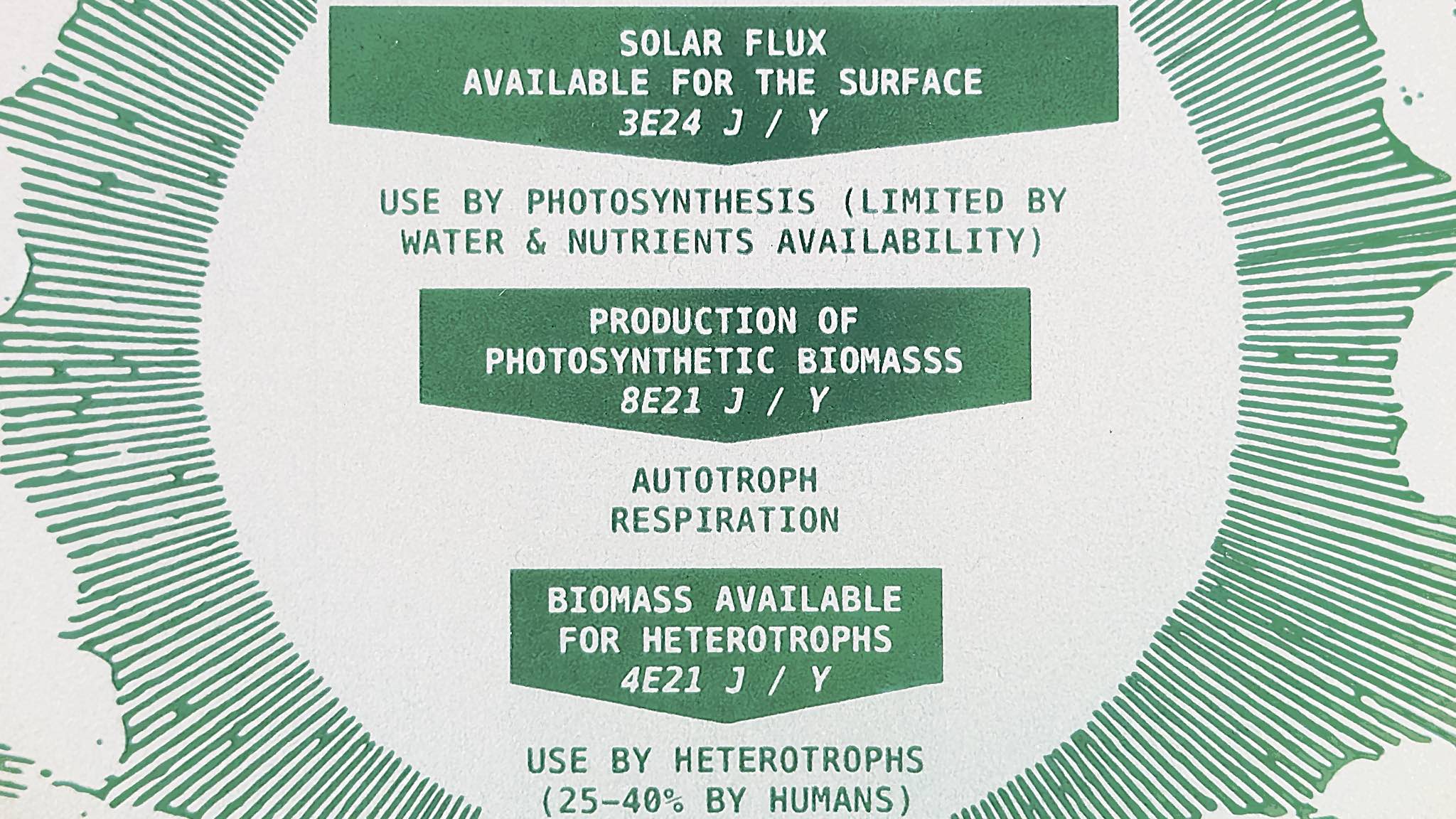
ENERGY FLOW (11) This plate traces the successive reductions of the solar flow, from its arrival on Earth to its partial conversion into photosynthetic biomass, and then into resources available to heterotrophic organisms, including humans. It shows that photosynthesis captures only a small fraction of the incoming energy, and that this already reduced share must then be divided among countless uses and forms of life. Sustainability therefore does not depend on an abstractly “abundant” energy, but on a limited, situated, measurable, and ecologically mediated portion.
Sources and further reading
Christopher B. Field et al., “Primary Production of the Biosphere: Integrating Terrestrial and Oceanic Components”, Science, 1998.
Steven W. Running et al., “A Continuous Satellite-Derived Measure of Global Terrestrial Primary Production”, BioScience, 2004.
NASA Earth Observations, “Net Primary Productivity (1 year - Terra/MODIS)”.
MODIS Science Team, “MODIS Daily Photosynthesis (PSN) and Annual Net Primary Production (NPP) Product”, NASA, 1999.
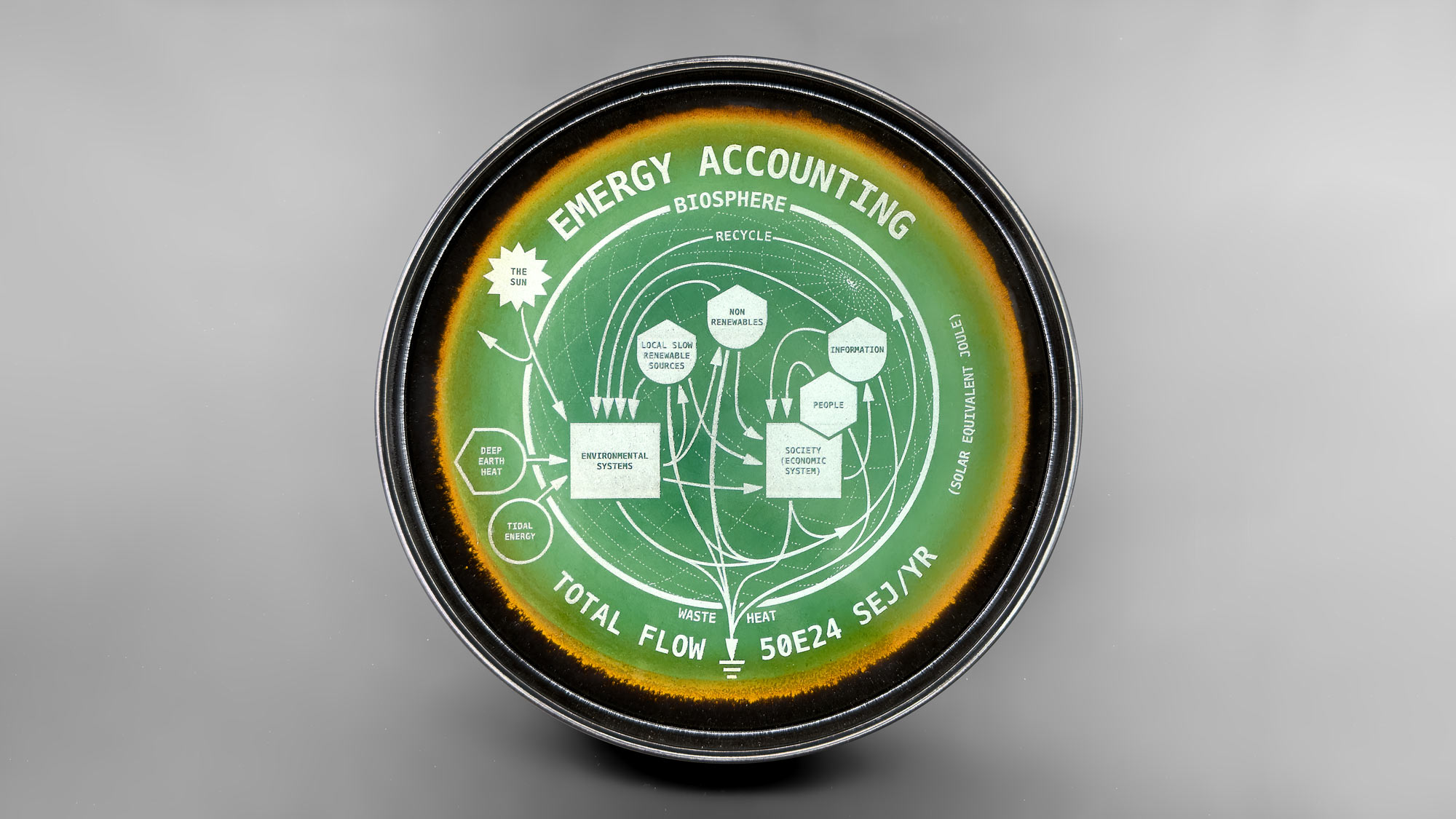
EMERGY ACCOUNTING (12) This plate presents the logic of emergy developed by Howard T. Odum: expressing ecological flows, materials, human labor, and information in a common unit, the solar equivalent joule. This method remains debated, particularly regarding its conversion factors and boundary choices, but it has critical power: making the energetic density of goods and services perceptible. Here, emergy accounting acts less as a tool of absolute precision than as a shift in perspective: each object becomes the condensation of a long history of solar energy transformations.
Sources and further reading
Howard T. Odum, Environmental Accounting: EMERGY and Environmental Decision Making, 1996.
Howard T. Odum, Mark T. Brown and Sherry L. Brandt-Williams, Handbook of Emergy Evaluation, 2000.
Mark T. Brown and Sergio Ulgiati, “Emergy Analysis and Environmental Accounting”, in Encyclopedia of Energy, 2004.
Mark T. Brown and Sergio Ulgiati, “Energy quality, emergy, and transformity”, Ecological Modelling, 2004.